 |
|
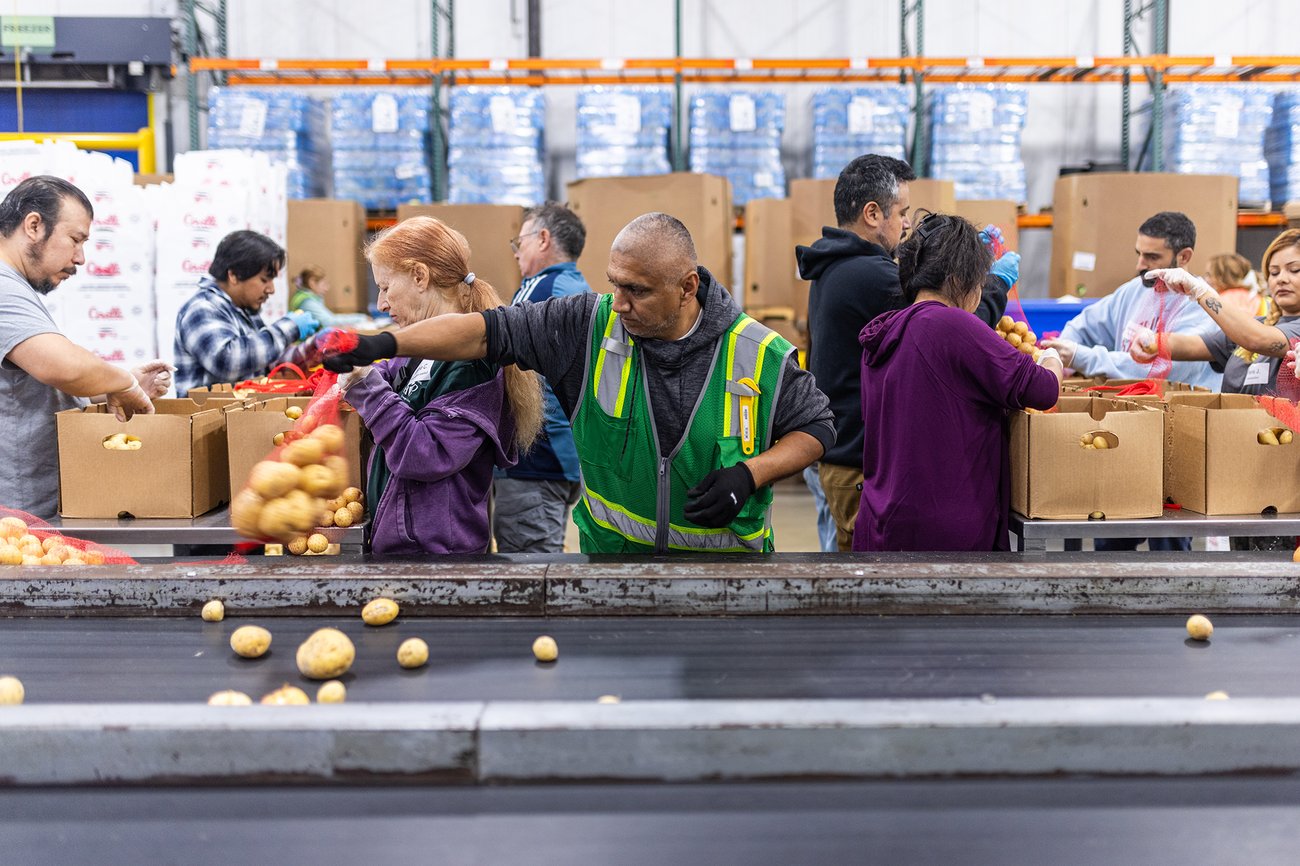
Workers, volunteers and National Guard troops sort fresh produce at Los Angeles Regional Food Bank in preparation for the end of SNAP benefits, in Los Angeles on Oct. 30, 2025. Photo by J.W. Hendricks for CalMatters |
|
|
|
Good morning, CalMatters reader.
Half of lower-income Californians say they’ve had to cut back on food in the past year to save money. That’s according to a statewide survey of 2,306 adults conducted last month by the Public Policy Institute of California. Among the other key findings of the Californians and Their Economic Well-Being study: most Californians believe that the economy is the most important issue facing the state, and they’re overwhelmingly pessimistic about the coming year. About 68% of the adults surveyed said they anticipate “bad times financially” over the next 12 months, up from 56% in December 2024. The Golden State has the highest unemployment and poverty rates in the nation.
Many lower-income Californians described their financial situation to PPIC surveyors as stressed or falling behind. Seven in 10 adults said that the gap between the rich and the poor is getting larger in their part of California and that children growing up in California today will be financially worse off than their parents. While roughly three-in-10 adults in California say they’re worse off financially than a year ago, the largest group, 55%, say their situation is “about the same.”
|
|
|
|
|
Our nonprofit, nonpartisan newsroom depends on support from people like you.
|
|
|
|
|
Despite the strains and economic anxiety about the future, many reported stable employment: 88% of those employed said they have stable pay, 83% said they enjoy predictable hours, and 82% said they receive paid sick leave. Surveyors spoke with Democrats, Republicans, and independents in the Central Valley, the Inland Empire, Los Angeles, the Bay Area, and Orange and San Diego counties. More than half of those polled said they were likely voters. 52% of the total Californians surveyed said they approved of how Gov. Gavin Newsom is handling the economy and jobs, while only 27% approved of the job President Donald Trump is doing on that front.
Majorities across regions and income levels favored strong support for workers: 79% said they supported increased funding for job training. The survey revealed that the rapid deployment of artificial intelligence is also causing concerns about job security and future employment opportunities. Of those surveyed, 73% want expanded eligibility and increased payments for the Earned Income Tax Credit, and 76% want the state to ease permitting to allow more housing development.
|
|
|
|
|
|
-
Racist graffiti. Officials at San Jose State University are investigating two separate incidents of racist and threatening graffiti being found on campus. The graffiti reportedly invoked white supremacist language and threatened a mass shooting targeting Asian, Jewish, and Muslim community members, according to the San Francisco Bay Area office of the Council on American-Islamic Relations, a Muslim civil rights and advocacy organization.
-
Representation matters. The American Immigration Council has a new interactive data tool that examines how legal representation, geography, and other factors shape outcomes in immigration proceedings. Between fiscal years 2019 and 2024, 62% of immigrants without a lawyer were ordered deported, compared to 27% of those who did have legal aid.
-
Child farmworkers. Pulitzer Prize-winning journalist Robert J. Lopez found that thousands of children and teenagers are toiling in California’s agricultural industry, and the state is failing to protect their health and safety. An investigation for Capital & Main and the Los Angeles Times found the state’s enforcement of child labor laws is negligible in California’s fields. Underage farmworkers are working under troubling conditions, including extreme heat and exposure to pesticides.
-
Federal mask ban. Democratic Reps. Scott Peters of California, Dan Goldman of New York and Raja Krishnamoorthi of Illinois announced Thursday new legislation aimed at establishing stronger standards for federal immigration agents' use-of-force. The Stop Excessive Force in Immigration Act would prevent agents from being equipped with tear gas, pepper balls, and flash bangs, and stop them from wearing masks and using non-identifying uniforms, except in limited exceptions for operations targeting national security threats.
-
Pesticide watch. The Department of Pesticide Regulation is hosting a public meeting at 3 p.m. on Dec. 10 for the new Environmental Justice Advisory Committee, established by Assembly Bill 652. The meeting is open to the public.
|
|
|
|
|
Advertisement |
 |
|
|
|
-
Fruits and vegetables. A CalFresh program, known as the CalFresh Fruit and Vegetable EBT Program, just relaunched with $36 million in state funding secured by Assemblymember Alex Lee, a Democrat from Milpitas. The program provides up to $60 in extra CalFresh benefits to families every month to use at local stores.
-
Public charge rule. The Trump administration is proposing a new “public charge” policy that would give immigration officers broader authority to deny permanent residency to immigrants lawfully present in the country who have used certain public programs, such as Medicaid, food or housing assistance.
-
App takedowns. The Electronic Frontier Foundation is suing the federal government over its demands that tech companies remove apps that document immigration enforcement activities. Tech platforms took down apps, such as ICE Block, Red Dot, and DeICER, and webpages like ICE Sighting-Chicagoland, following communications with federal officials this year. EFF says the app removals raise questions about government coercion to restrict protected First Amendment activity.
-
Trucker licenses. The Trump administration is cracking down on immigrants who drive trucks in California, creating new regulations and threatening to withhold millions in federal highway funding over alleged violations by the state’s DMV. Newsom says those allegations are a lie, CalMatters reporter Adam Echelman reports.
-
Prison costs. The independent Legislative Analyst’s Office says the California Department of Corrections and Rehabilitation is almost $1 billion over budget, contributing to the state’s nearly $18 billion budget hole for 2026. Newsom has overseen the closure of four state prison facilities, with a fifth closure planned for next fall.
Thanks for following our work on the California Divide team. While you’re here, please tell us what kinds of stories you’d love to read. Email us at inequalityinsights@calmatters.org. |
|
|
|
|
|
|
Wendy Fry
California Divide Reporter |
|
|
|
|
|