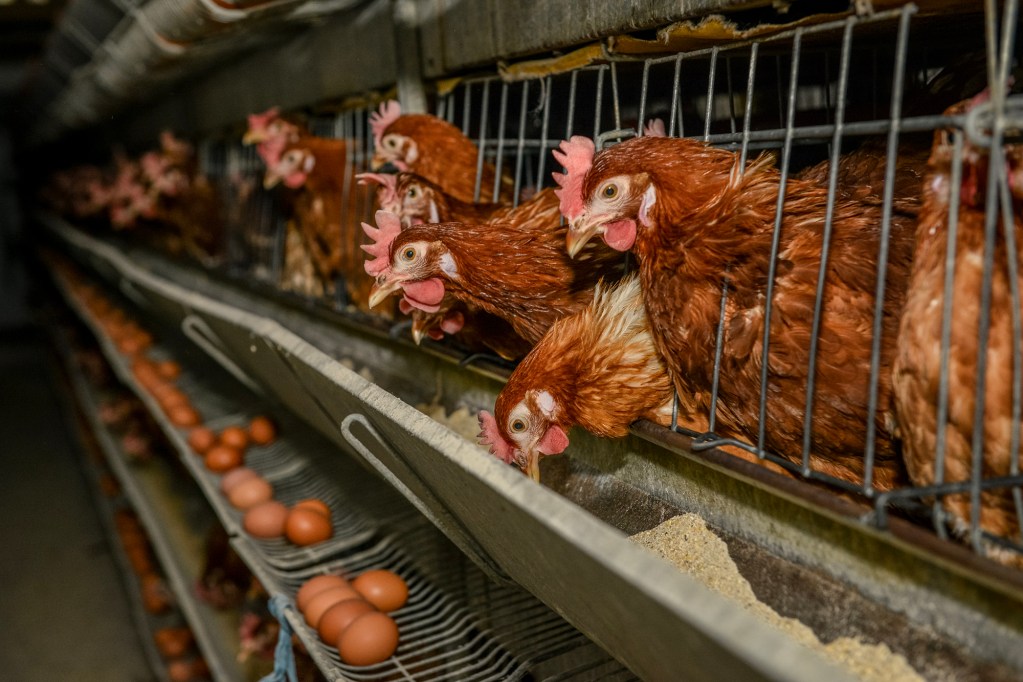
The U.S. Department of Labor reached a $3.8 million settlement with a Los Angeles poultry factory that employed minors as young as 14 for dangerous jobs.
Chickens in poultry factory. Photo via iStock Photo
Good morning, Inequality Insights readers. I’m CalMatters reporter Felicia Mello.
A new front opened in the debate over child labor last week when the U.S. Department of Labor reached a $3.8 million settlement with a Los Angeles poultry factory that employed minors as young as 14 for dangerous jobs, including cutting meat with sharp knives and driving forklifts.
In an interview with my colleague Alejandra Reyes-Velarde, a Department of Labor attorney described a dystopian workplace in which children stood hunched over tables in a cold warehouse for as long as 12 hours a day, slicing meat as fast as they could to earn more money.
The child workers employed at The Exclusive Poultry Inc were indigenous Guatemalans who spoke little English or Spanish, said the attorney, Nisha Parekh. Some had deep cuts on their arms or hands.
YEAR-END DRIVE Our nonprofit and nonpartisan newsroom depends on member support. Please become a member today, every donation is critical to protect this journalism on essential inequality issues. Double your donation →
“They wouldn't go to the hospital for that. The employer just slapped a band-aid on and they'd just keep cutting,” she said.
Factory owner Tony Bran said in court documents that he relied on subcontractors to hire and interact with workers at the factory, which the Department of Labor said supplied poultry to Ralph’s, ALDI, Grocery Outlet and Sysco. (Some of the companies denied receiving poultry from the plant.)
Working in meat processing can be especially hazardous for children since it’s one of the country’s more dangerous industries. The Department of Labor launched an investigation into a Mississippi poultry plant earlier this year after a 16-year-old boy died on the job.
“Employers who violate the (Fair Labor Standards Act) and their downstream distributors and customers should be on notice that we will use all tools at our disposal to protect workers, regardless of age and immigration status,” the department said in a statement.
Hunger pangs. More than 1 in 5 California families lacked reliable access to healthy food as of October, the California Association of Food Banks reported Tuesday. Food insecurity rose after pandemic-era food aid programs expired.
A student protest about the war between Israel and Gaza at the University of California, Berkeley's Sather Gate on Oct. 16, 2023. Photo by Michael Liedtke, AP Photo
Campus discrimination. Stanford, UCLA and UC San Diego are among six colleges being investigated by the U.S. Department of Education for possible antisemitic or Islamophobic discrimination, NBC reports. Debate over the line between free speech and bigotry has raged on California campuses as the war in Gaza intensified.
Probing poverty. “Many of us are contributing to poverty in America in ways that often we do not
recognize,” Pulitzer Prize-winning sociologist Matthew Desmond says in a Q&A with the San Diego Union-Tribune. His new book, “Poverty, by America,” elaborates.
Advertisement
Homeless advisors. Santa Cruz County is trying a novel approach to come up with solutions to homelessness, the Santa Cruz Sentinel reports: it’s actually asking homeless people.
Record rent burdens. More low-income people than ever are spending more than half their incomes on rent, the New York Times reports – imposing what one sociologist called “a
constant mental and emotional tax.”
Demographic shift. California’s Latino population is changing: Venezuelan and Dominican communities have more than doubled in size since 2010, while the number of people who identify as Mexican – who make up 30% of Californians – increased more slowly.
Thanks for following our work on the California Divide team. While you’re here, please tell us what kinds of stories you'd love to read.
California Divide is a statewide media collaboration to raise awareness and engagement about poverty and income inequality through in-depth, local storytelling and community outreach. The project is based at CalMatters in Sacramento with a team of reporters deployed at news organizations throughout California.