Kipp Kahlia at her home in Long Beach. Photo by Julie A. Hotz for CalMatters
Good morning, Inequality Insights readers. I’m CalMatters reporter Wendy Fry.
This week’s dispatch comes from California Divide reporter Alejandra Reyes-Velarde who writes about one of the largest guaranteed-income programs in the nation. L.A. County’s Breathe program gives participants $1,000 monthly for three years. It's more money over a longer period than similar programs.
Guaranteed income is a monthly cash payment given directly to individuals. It is unconditional — with no strings attached on how to spend it and no work requirements. It is meant to supplement, not replace, the existing social safety net.
The Breathe pilot program — with 1,200 participants including 200 former foster youth — allows researchers to track the impact in a large, diverse region, Sean Kline told CalMatters. Kline is director of the Stanford Basic Income Lab, which tracks the more than 150 guaranteed income programs across the country.
Did someone forward this email to you? Inequality Insights is a free weekly must-read newsletter helping Californians stay in-the-know on inequality issues. Sign up →
For recipients, the program gives them a little bit of breathing room. They’re able to spend less time struggling to survive and more time focusing on their goals.
“It’s taking me from always putting out fires to being able to actually make some moves to advance, not just being stuck,” said Kipp Kahlia, a Long Beach guitarist and one of the Breathe recipients.
Some opponents said these types of programs discourage participation in the labor market, are too costly, and fail to reform the welfare system sufficiently to bring working people out of poverty. Most of these programs don’t yet have published results, and it’s unclear how they’ll contribute to federal policy.
California saw a rise in poverty as pandemic aid ended, with the state’s poverty rate increasing from about 11% in 2021 to 13% in early 2023. This left approximately 5 million Californians below the poverty line.
Recipe for change? A first-in-the-nation fast food council will offer California workers and labor advocates a way to set industry working conditions, hammering out rules directly across the table from franchise owners and representatives of restaurant chains such as McDonald’s and Burger King. The council is supposed to start meeting by March 15, and its decisions will be sent to state labor agencies to decide if they’ll become real
regulations, CalMatters’ Jeanne Kuang reports.
Home sweet … costly home. A new report from Harvard University reveals that housing was unaffordable for a record half of U.S. renters in 2022, with many paying more than 30% of their income for rent and utilities. The study also found that a cooling housing market might not alleviate the struggles of those most in need. Prices for many people are still higher than before the pandemic, and a building boom is not likely to change that, NPR reported.
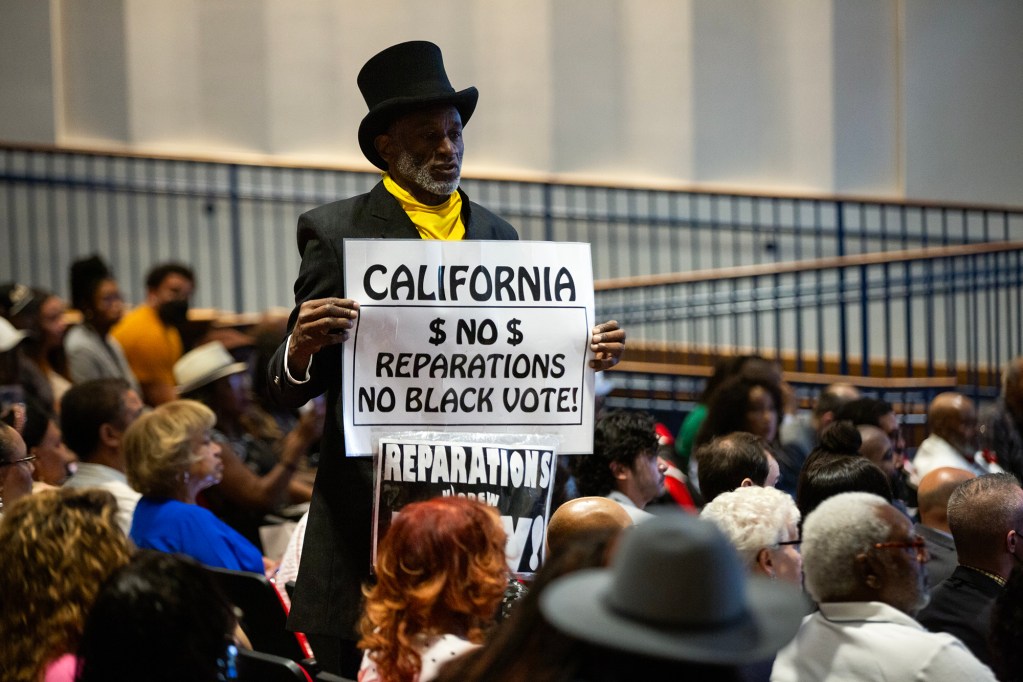
Morris Griffin holds a sign at the Reparations Task Force hearing June 29, 2023. Photo by Semantha Norris, CalMatters
Reparations unveiled. The California Legislative Black Caucus announced Wednesday a reparations bill package — a group of 14 proposed laws the caucus has introduced or plans to introduce this legislative session. Ranging from criminal justice reform to food justice, the group of proposed laws is aimed at “dismantling the legacy of slavery and systemic racism,” said state Assemblymember Lori Wilson, a Democrat from Suisun City and chair of the Black Caucus. Notably, none of the proposed bills includes widespread monetary compensation for descendants of slavery, as was recommended by the state’s reparations task force.
COVID debt due. Renters in the city of Los Angeles faced a big deadline this week, the LAist reports. If they didn’t repay all of the rent debt they accrued earlier in the COVID-19 pandemic by Feb. 1, they could end up evicted. City outreach workers and nonprofits are scrambling to offer assistance to those tenants to prevent another eviction spike.
Permit politics. Fontana’s first Black mayor, Acquanetta Warren, has been driving a crackdown on street food vendors selling goods without proper permits, leading to potential arrests and impoundment of food and equipment. Critics are accusing city leaders of an ethnically motivated crackdown on working-class Latinos, while Warren’s defenders argue that backlash is racist in nature.
Advertisement
Period poverty. State Sen. Nancy Skinner, a Democrat from Oakland, cheered this week a unanimous vote in favor of her proposed law that would require restrooms in buildings owned and used by the state to be always stocked with menstrual products, available and accessible to employees and the public, free of cost. Now the bill goes to the Assembly. Harvard University says nearly 22 million women living in poverty
in the U.S. cannot afford menstrual hygiene products, a problem known as period poverty.
Income objection. Judicial Watch sued to halt San Francisco’s guaranteed income program for low-income transgender residents this week. The conservative group said the program discriminates in favor of biological Black and Latino transgender individuals who identify as women. To qualify for the $1,200 monthly payments, the recipients had to earn $600 or less a month in regular income, The San Francisco Standard reports.
Real cost calculator. Want to know how much it really costs to live in a city or county once expenses like housing, transportation, and childcare are factored in? Try the new family budget calculator by the left-leaning Economic Policy Institute. It says a single parent of
two needs to earn $166,000 annually to live in the San Francisco area, $133,000 for the San Diego-Carlsbad region, $123,000 for metro Los Angeles and $115,000 for Sacramento.
Thanks for following our work on the California Divide team. While you’re here, please tell us what kinds of stories you'd love to read.
Thanks for reading, and you’ll hear from us again next week, The California Divide Team
California Divide is a statewide media collaboration to raise awareness and engagement about poverty and income inequality through in-depth, local storytelling and community outreach. The project is based at CalMatters in Sacramento with a team of reporters deployed at news organizations throughout California.