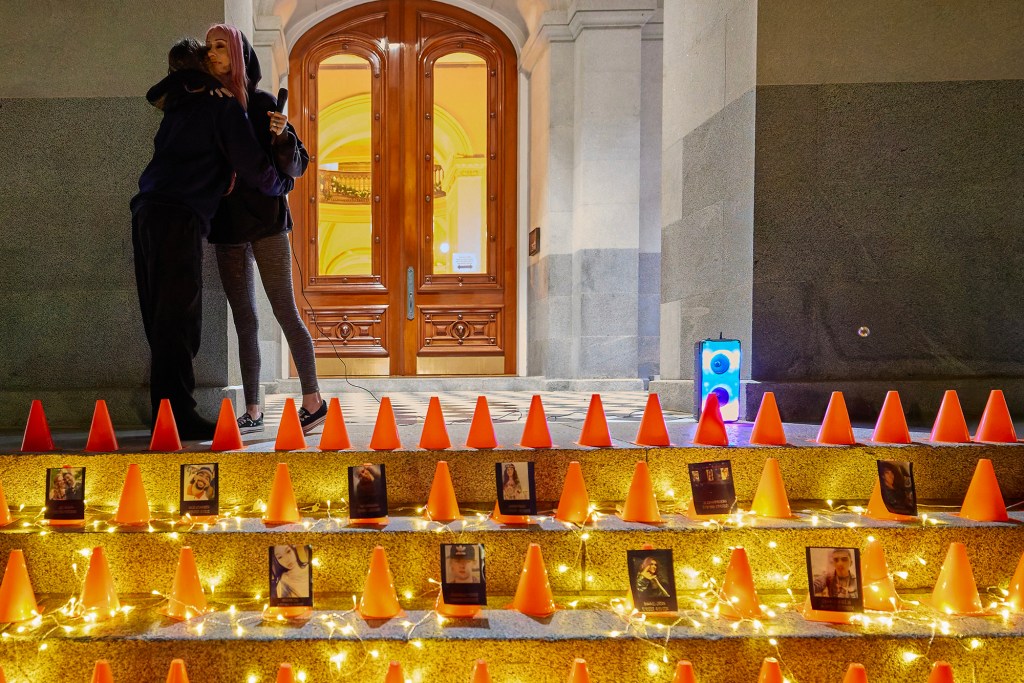
Erika Pringle (right) embraces Allison Lyman, whose son died in a collision, during a candlelight vigil at the state Capitol in Sacramento on Nov. 16, 2025. Photo by Fred Greaves for CalMatters
Over the past decade, the number of people dying on California’s roads have shot up dramatically. Nearly 40,000 people have died and more than 2 million have been injured.
And California’s leaders have done little about it.
CalMatters investigative reporters Robert Lewis and Lauren Hepler have spent the year detailing how the state allows dangerous drivers to stay on the road, with deadly consequences. In the latest installment of their License to Kill series today, they write:
Year after year, officials with the power to do something about it — the governor, legislators, the courts, the Department of Motor Vehicles — have failed to act.
The silence, in the face of a threat that endangers nearly every Californian, is damning.
Colin Campbell, a writer and director in Los Angeles, lost his two teenage children after a repeat drunk driver slammed into his Prius on the way to the family’s new home in Joshua Tree. He then began advocating for California to join most other states and create a law requiring in-car breathalyzers for anyone convicted of a DUI.
The ACLU opposed the measure, calling it “a form of racialized wealth extraction.” The DMV told lawmakers that it could not “complete the necessary programming” for the law.
So the bill was gutted. California couldn’t do something that nearly three dozen other states could.
Campbell: “Our lives were destroyed that night. If these people's children had been killed by a drunk driver, there is no way they would be objecting to this.”
Steve Gordon, whom Gov. Gavin Newsom picked to run the DMV in 2019, won’t talk about the rise in deaths. He has declined or ignored CalMatters requests for an interview.
Triple your impact: Every gift to CalMatters right now is matched twice to triple your impact. Back independent journalism for all Californians today. Please give now.
Advertisement
Other Stories You Should Know
Duplexes matter, too, argues pro-development group
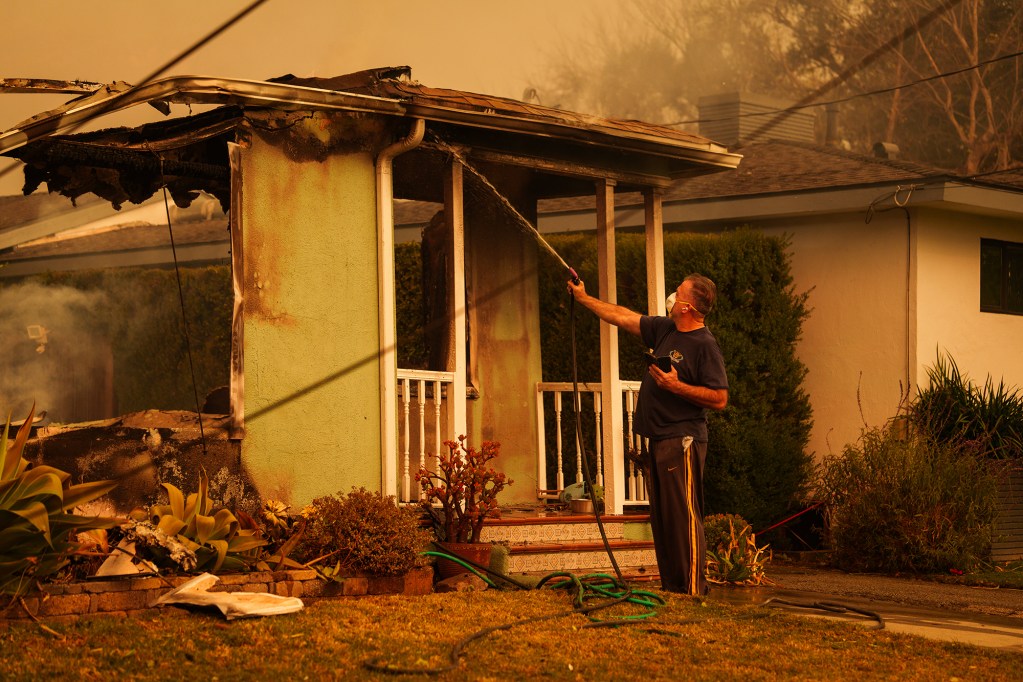
A person sprays water on the flames of a house to prevent the Eaton Fire from spreading in Pasadena on Jan. 8, 2025. Photo by Jules Hotz for CalMatters
From CalMatters housing reporter Ben Christopher:
State and local lawmakers have hastened to make it easier, quicker and cheaper to rebuild after the L.A. fires — with a glaring exception.
In July, Newsom issued an executive order suspending a law to allow homeowners to split their properties in two and build duplexes on each parcel in very high-risk zones within the L.A. fire footprints.
Newsom’s decision came at the urging of L.A. Mayor Karen Bass, former reality TV star Spencer Pratt and many hill dwellers who argued that packing more homes into fire-prone hills could clog evacuation routes.
The pro-development legal advocacy group, YIMBY Law, sued Newsom on Wednesday, along with Bass and local governments across the region, arguing that they overstepped their constitutional authority.
YIMBY Law Director Sonja Trauss said in a statement that suspending the law “raises the barrier of who gets to come back at all.”
Judge calls Trump admin’s position ‘shocking’
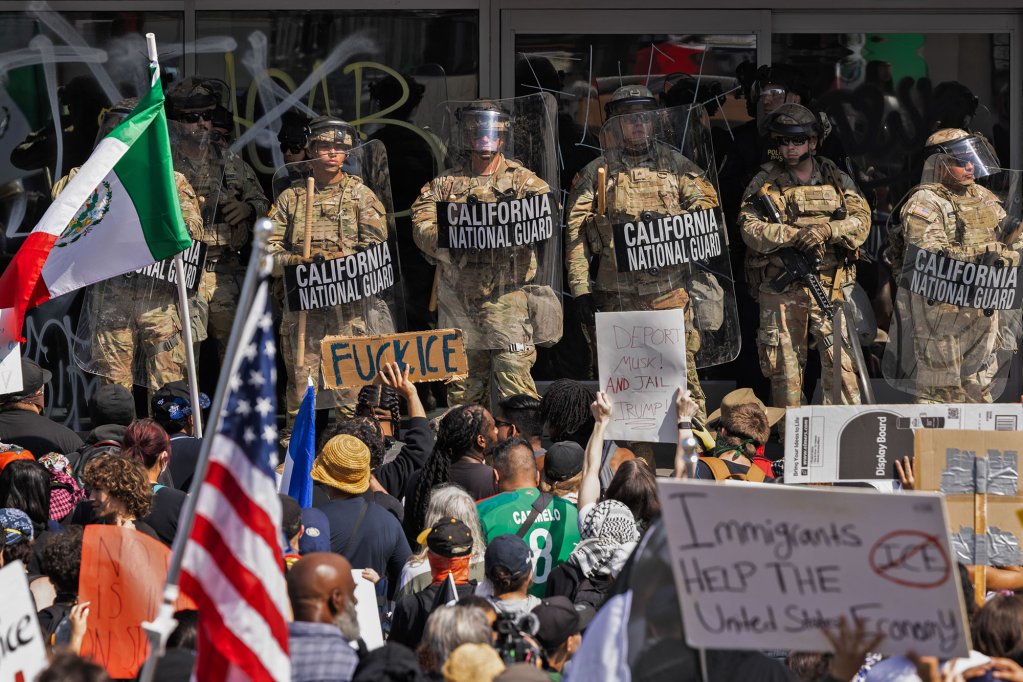
Demonstrators protest against immigration raids as National Guard officers stand guard in front of a federal building in Los Angeles on June 9, 2025. Photo by Ted Soqui for CalMatters
In a loss to President Donald Trump’s administration, a federal judge on Wednesday ordered the California National Guard out of L.A. and its troops to be returned under Newsom’s control, writes CalMatters’ Nigel Duara.
U.S. District Court Judge Charles Breyer in San Francisco issued the order, writing that it is “profoundly un-American to suggest that people peacefully exercising their fundamental right to protest constitute a risk justifying the federalization of military forces.”
Breyer also disagreed with the administration’s argument that it should be permitted to perpetually, and without review, federalize a state’s National Guard, calling it “shocking.”
In June, Trump federalized the California National Guard in response to protests against federal immigration raids in Southern California. He then mobilized troops in other Democratic-led cities, such as Chicago and Portland. The L.A. case is one of several lawsuits challenging Trump’s National Guard deployments, with one case currently before the U.S. Supreme Court.
Breyer’s order goes into effect on Monday at noon, at which time the administration can file an appeal.
And lastly: Funds for rural schools await Trump’s sign-off
Students in a classroom at Achieve Charter School of Paradise in Paradise on May 21, 2025. Photo by Miguel Gutierrez Jr., CalMatters
After advancing through Congress this week, a bill to restore a federal program that provides millions of dollars to rural schools, including those in California, now awaits Trump’s approval. The program risked elimination earlier this year, after it initially fell victim to the Trump administration’s cost-cutting measures. Read more from CalMatters’ Carolyn Jones.
Advertisement
California Voices
CalMatters columnist Dan Walters: The Trump administration’s rule change to increase annual water deliveries in California will likely spark a legal battle that underscores the state’s neverending water wars.
CalMatters contributor Jim Newton: Crime has gone down at L.A.’s MacArthur Park, but blight and filth remain as painful reminders of how far the area has to go.
The forces behind the 1930’s Mexican Repatriation are reemerging under Trump’s deportation campaign, which is about advancing an idealized and fundamentally white vision of the U.S., writes Sylvia Zamora, sociologist at Loyola Marymount University.